Research, Publication and Projects
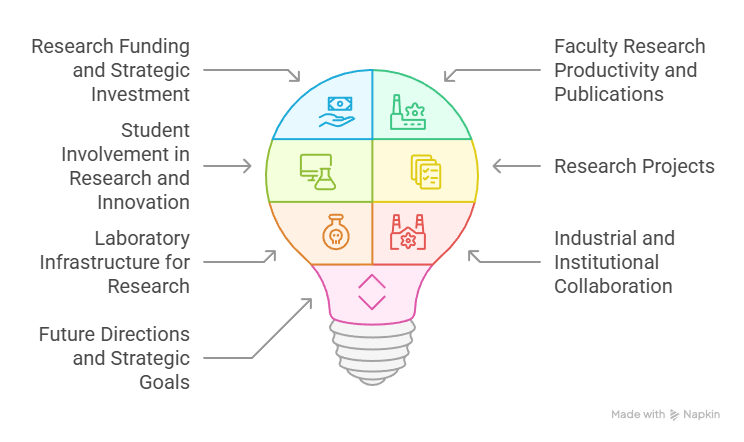
1. Research Funding and Strategic Investment
The department’s research agenda is supported by a structured and substantial budgetary allocation from MIST, reflecting the institute’s commitment to fostering innovation and applied research. Over the fiscal years 2023–2025, the NSE department successfully secured and utilized research grants totaling BDT 82.96 lakhs (approx. USD 78,000) for 15 distinct research projects. These projects span critical areas such as:
- Reactor safety and neutronics analysis
- Advanced materials for radiation protection
- Sustainable extraction technologies using supercritical fluids
- Environmental monitoring and heavy metal detection
- Biomedical and industrial applications of nuclear technology
This strategic investment underscores MIST’s vision to develop world-class research infrastructure and promote cutting-edge, interdisciplinary research.
2. Faculty Research Productivity and Publications
The intellectual capital of the NSE department is reflected in the substantial research output of its faculty members. Between 2023 and 2025, full-time and part-time faculty published over 60 peer-reviewed journal and conference papers. Notable contributors include:
- Professor Dr. Abdus Sattar Mollah: 21 publications in radiation physics and medical applications.
- Professor Dr. Mokhlesur Rahman: 8 publications in nuclear chemical engineering.
- Lt Col Md. Altab Hossain, PhD: 16 publications in reactor thermal-hydraulics and AI applications.
- Emerging early-career researchers (lecturers and research assistants) have also contributed significantly, with multiple publications in high-impact journals.
Faculty members are actively engaged with prestigious professional societies such as the American Physical Society, Institute of Nuclear Materials Management (INMM), Bangladesh Physical Society, and Institute of Engineers, Bangladesh (IEB), facilitating global networking and collaborative research opportunities.
3. Student Involvement in Research and Innovation
Undergraduate and postgraduate students are integral to the department’s research mission. The Final Year Design and Research Project (NE 400) serves as a capstone experience, enabling students to undertake substantial research under faculty supervision. In the academic year 2024–2025 alone, 25 thesis projects were completed, addressing topics such as:
- Burnup analysis of VVER-1200 reactors using OpenMC
- Development of bullet-resistant composite vests using ANSYS
- Green extraction of essential oils using supercritical CO₂
- Thermal-hydraulic safety analysis of pressurized water reactors
Students also participate in national and international conferences, such as the 4th International Conference on Energy and Power (ICEP 2022) hosted by MIST, and workshops organized by the International Centre for Theoretical Physics (ICTP).
4. Research Projects:
The department maintains a pipeline of ongoing and completed research projects that align with national priorities and global technological trends. Selected funded projects (2023–2025) include:
|
Fiscal Year |
Project Title |
Funding (BDT) |
Status |
|
2023–2024 |
Analysis of neutronics safety parameters for Rooppur nuclear power reactor (VVER-1200) |
4,60,000 |
✅ Completed |
|
2023–2024 |
Development of water-repellent jute-based composite materials |
6,50,000 |
✅ Completed |
|
2024–2025 |
Burnup analysis for VVER-1200 using ORIGEN and OpenMC codes |
6,12,500 |
🔄 Ongoing |
|
2024–2025 |
Modeling and analysis of bullet-resistant composite vest using ANSYS |
6,75,000 |
🔄 Ongoing |
|
2025–2026 |
Innovative development of cut-resistant vests with multi-layered fabric structures |
5,00,000 |
🔄 Ongoing |
These projects not only advance academic knowledge but also offer tangible solutions to industrial, environmental, and security challenges.
5. Laboratory Infrastructure for Research
The department’s eight specialized laboratories provide the necessary technical foundation for experimental and computational research. Key facilities include:
- Modelling and Simulation Lab: Equipped with ANSYS, COMSOL, RELAP, OpenMC, and MATLAB for reactor design and safety analysis.
- Nuclear Technique and Materials Lab: Supports materials characterization and irradiation studies.
- Radiation Detection & Medical Application Lab: Facilitates research in health physics and nuclear medicine.
- Thermo-Fluid Dynamics Lab: Used for thermal-hydraulic experiments and heat transfer studies.
A dedicated roadmap for laboratory development (2024–2030) ensures continuous upgrading of equipment and capabilities, keeping pace with evolving research demands.
6. Industrial and Institutional Collaboration
The department fosters strong ties with industry and research organizations through its Industrial Advisory Panel (IAP), which includes experts from the Bangladesh Atomic Energy Commission (BAEC), Nuclear Power Plant Company Bangladesh Ltd. (NPCBL), and international bodies. These collaborations facilitate:
- Joint research projects
- Internship and industrial training opportunities
- Curriculum feedback and modernization
- Guest lectures and workshop co-organization
7. Future Directions and Strategic Goals
Looking ahead, the NSE department aims to:
- Expand research in nuclear safety, security, and safeguards
- Enhance capabilities in nuclear fusion and plasma engineering
- Increase international publication output and patent filings
- Strengthen student-led research initiatives through dedicated funding and mentorship